





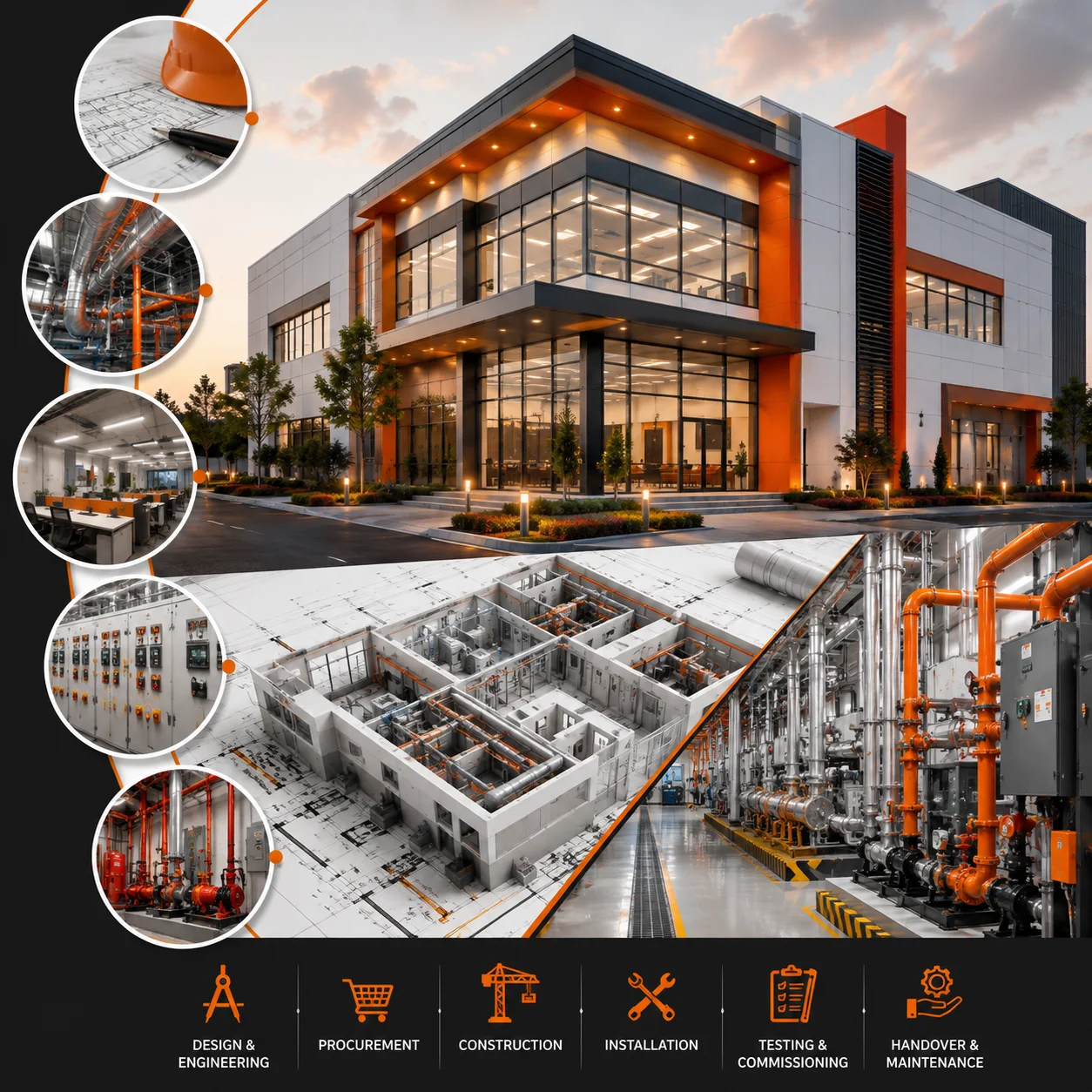
Turnkey Projects: Complete Solutions from Design to Delivery
Category: Turnkey Projects & Engineering Solutions
Introduction
Turnkey projects provide clients with a complete solution in which a single project partner takes responsibility for planning, design, procurement, construction, installation, testing, commissioning, and final handover.
This approach simplifies project management by bringing multiple activities under one coordinated team. Turnkey solutions are widely used for commercial buildings, industrial facilities, healthcare projects, hospitality developments, offices, retail spaces, and other complex infrastructure projects.
What Is a Turnkey Project?
A turnkey project is a project delivered as a complete, ready-to-use facility or system. The client provides the project requirements, while the turnkey contractor manages the major activities required to deliver the finished project.
The objective is to provide the client with a fully functional solution that is ready for operation after completion and commissioning.
A successful turnkey project combines design, engineering, procurement, construction, installation, testing, and commissioning into one coordinated delivery process.
Why Choose Turnkey Project Solutions?
Managing a complex construction or engineering project through multiple independent contractors can create coordination challenges. Turnkey project delivery provides a single point of responsibility for the overall project.
- Single point of project responsibility
- Better coordination between different trades
- Streamlined project management
- Improved schedule control
- Better cost management
- Reduced coordination issues
- Integrated engineering and construction
- Complete testing and commissioning
- Ready-to-use project handover
Major Stages of a Turnkey Project
1. Requirement Analysis
Every turnkey project begins with understanding the client's requirements, objectives, budget, operational needs, site conditions, timeline, and expected project outcomes.
A detailed requirement analysis helps establish the project scope and provides a clear foundation for design and execution.
2. Concept Development
Once the requirements are established, the project team develops an initial concept covering space planning, engineering requirements, system selection, project approach, and preliminary cost considerations.
3. Design and Engineering
Detailed architectural, structural, mechanical, electrical, plumbing, fire protection, HVAC, and other engineering designs are prepared according to the project requirements.
Proper coordination between different engineering disciplines is essential to avoid conflicts during construction and installation.
4. Procurement
Procurement involves sourcing materials, equipment, systems, and other resources required for project execution. Material selection should consider quality, performance, availability, durability, budget, and project specifications.
5. Construction and Installation
The construction phase involves executing the approved designs at the project site. Civil works, interior works, MEP installations, equipment installation, and other project activities are coordinated according to the project schedule.
6. Testing and Commissioning
After installation, systems and equipment are inspected, tested, balanced, and commissioned to verify that they operate according to the required performance criteria.
7. Final Handover
Once the project has successfully completed testing and commissioning, the completed facility or system is handed over to the client.
Handover documentation may include drawings, equipment details, test reports, operation and maintenance information, warranties, and other relevant project records.
Engineering Services in Turnkey Projects
Turnkey projects often involve multiple engineering disciplines working together to create a fully integrated facility.
- HVAC Engineering
- Electrical Engineering
- Plumbing and Water Networks
- Fire Protection Systems
- Mechanical Engineering
- Building Management Systems
- Interior Fit-Out
- Energy Management Systems
- Safety and Compliance Systems
Importance of Project Coordination
Coordination is one of the most important aspects of turnkey project execution. Multiple teams, contractors, suppliers, and engineering disciplines must work together toward a common completion target.
Effective coordination helps minimize design conflicts, construction delays, material shortages, rework, and unexpected costs.
Digital design and Building Information Modelling can also support coordination by allowing different project disciplines to review and coordinate their designs before construction.
Quality Management in Turnkey Projects
Quality management should be implemented throughout the entire project lifecycle rather than only during final inspection. Materials, workmanship, installations, and completed systems should be inspected at appropriate stages.
- Material quality inspection
- Design verification
- Installation inspections
- Equipment testing
- System commissioning
- Documentation and reporting
- Final inspection and snagging
Turnkey Projects and Cost Control
Cost management is an important part of turnkey project delivery. Early planning and coordinated procurement can help control project expenditure and reduce unexpected costs.
A clearly defined project scope helps establish realistic budgets and reduces the possibility of major changes during construction.
Value engineering can also be used to identify practical alternatives that maintain required performance while improving cost efficiency.
Turnkey Project Management
Professional project management ensures that the project is delivered according to the agreed scope, schedule, quality requirements, and budget.
Project managers coordinate engineering teams, suppliers, contractors, consultants, clients, inspections, documentation, schedules, and site activities throughout the project lifecycle.
Benefits of Turnkey Project Delivery
- Single point of responsibility
- Simplified project management
- Better coordination between disciplines
- Improved schedule management
- Better cost control
- Reduced project coordination risks
- Integrated engineering solutions
- Professional testing and commissioning
- Complete project documentation
- Ready-to-use facility or system
Applications of Turnkey Projects
Commercial Buildings
Turnkey solutions can be used for offices, business centers, shopping facilities, and other commercial developments requiring coordinated architectural and engineering services.
Industrial Facilities
Industrial turnkey projects may include factory buildings, production facilities, utility systems, mechanical installations, electrical systems, and specialized process infrastructure.
Healthcare Facilities
Hospitals and healthcare facilities require highly coordinated building services, including HVAC, electrical, plumbing, fire protection, and specialized systems.
Hospitality Projects
Hotels, resorts, restaurants, and other hospitality facilities can benefit from turnkey delivery to coordinate interior design, building services, guest facilities, and operational requirements.
Retail Spaces
Retail fit-outs and developments often require fast and coordinated execution. Turnkey delivery can integrate interior works, lighting, HVAC, electrical systems, plumbing, fire protection, and other services.
Technology in Turnkey Project Delivery
Modern turnkey projects increasingly use digital technologies to improve planning, coordination, monitoring, and documentation.
Building Information Modelling, project management software, digital progress monitoring, smart building systems, and data-driven project reporting can improve communication and project visibility.
Sustainable Turnkey Projects
Sustainability is becoming an important consideration in turnkey project delivery. Energy-efficient HVAC systems, LED lighting, efficient water systems, renewable energy solutions, sustainable materials, and intelligent building controls can help reduce the environmental impact of a project.
Sustainable design should be considered from the early planning stage so that energy and resource efficiency are integrated into the overall project rather than added at the end.
Conclusion
Turnkey projects provide a complete and coordinated approach to project delivery, covering activities from initial planning and design through procurement, construction, installation, testing, commissioning, and final handover.
By working with a single responsible project partner, clients can simplify project management, improve coordination, control costs, and achieve better visibility throughout the project lifecycle.
With professional engineering, quality management, modern technology, and effective project coordination, turnkey solutions can deliver reliable, efficient, and ready-to-use facilities that meet the specific requirements of modern businesses and organizations.